Nurses Rank #1 for 24th Year in a Row

Every year, since 1976, the Gallup Poll releases Ethics Rankings for American Professions. On January 12th, the Gallup Poll’s 2025 rankings were released and again ranked nurses at the top of the list for ethical standards. This result is the 24th consecutive year of ranking at the top of the list of professions.

I speak on this often but why this year feels different is due to the continued socio-technical challenges we face with finding the right balance between what humans can do (and should do) versus what technology can do (and should do) in healthcare.

I started my career as a bedside nurse. Every shift I strived to give the best possible care available to each of my patients. Sometimes this meant refusing patients because the ones I had needed me too much to take on another one. Sometimes this meant pushing the medical or surgical team to decide who was responsible for the patient because the data I had did not look quite right to me. Sometimes this meant spending hours sifting through papers to figure out when the newly transferred ICU patient was due for meds because it just was not at all as clear as it could be. “It’s all there” I might hear. (Yes, it is all there buried in dozens of pages of small print).

Your decisions are guided by what is best for the patient as well as what is ethically sound. The nurse patient relationship is essential to know that patient and for the patient to know one’s care. Establishing trust is critical for that relationship as patients are vulnerable to the care they receive and who is providing that care.

Therefore, as we advance technology such as artificial intelligence that is more complex for the population, there must also be awareness on how these tools do or don’t work. Any technology tool that is used becomes an extension of the human’s care delivery. With approximately 50% of the U.S. population concerned about the use of AI in daily life, this creates a potential for mistrust in the care environment if AI is not articulated, understood and effectively used consistently for care.

Thus, as nurses and healthcare professionals, it is critical that we advocate for the tools that can assist in ways that improve our experience in delivering quality patient care rather than replace core functions of what it means to be a nurse. The patients depend on it, even if they do not say it.

~ Dr. Kelley

Happy Nurses Week!

Happy Nurses Week!

May 6th marks the start of Nurses Week that runs through May 12th each year! The American Nurses Association indicates that there are over 3 million registered nurses in the United States. This means we have that many people around us who have dedicated their lives to improving the lives of others! That is a remarkable mission that deserves recognition.

Nurses play a fundamental role in advancing the health of individuals each day. Nurses go into this profession to heal and help others. Each one of us, as individuals, will need some form of health care service at some point in our lives. Our nurses are the lifeline to our health. In health care organizations, nurses are the health care professionals who are at our bedside 24 hours a day, 7 days a week. Yet, their nursing care does not stop at the bedside.

To paint the full picture, I’d like to share an excerpt of some words I spoke about the meaning of being a nurse….

“….what happens is that your profession as a nurse becomes part of who you are, your persona. You will be presented with situations that could benefit from your nursing knowledge and skills to help others. You will not always know when those situations will come but when they do, you will likely react instinctively and pitch in to help that individual, family, community or population in need.

Whether it is fielding a question from a friend about how much Tylenol to give her son that has a fever, advocating for a dying family member who is unable to advocate for his or herself, or simply listening to someone who is going through a difficult time. The possibilities are endless. Your nursing knowledge and skills can make an impact that will be memorable for you as well as that individual person or family.

Thus, as you move forward in your career as a nurse, what I would like for each of you to think about is the impact you will have not only in your professional life but also in those unexpected moments of your personal life when someone is in need of your care.

Regardless of where the need is located, your response to that need will not only benefit you as a nurse but also you as an individual. More importantly, the benefits will be far greater for those individuals, families, communities and populations who are on the receiving end of your efforts.” (See more at: https://nursing.duke.edu/news/tiffany-kelley-apply-your-nursing-knowledge-skills-day-day-pursuit-excellence#sthash.1rjHCKuX.dpuf )

Thus, This week we are celebrating nurses and the nursing profession! Each day during this week we will be showcasing a nurse on our blog who has been fundamental in advancing the nursing profession. We hope that you will be stimulated by the week and re-invigorated for what you do each day to help improve the lives of patients and families!

Best wishes,

Tiffany

Nurses, We want to Know Your Voice!

Our Know Your Voice contest is being launched to help support each of you, as nurses, you work to provide patients with the best possible care! If you are a nurse, please consider entering this contest. If you know a nurse, please consider telling him or her about this contest. What are we looking for? Well, let me share a few stories with you.

This week, I was speaking with a nurse about Know My PatientTM. We were talking about what life is like as a nurse on the floor. I mentioned how painful it can be to watch nurses struggle to access and use the electronic health record (EHR) while their primary focus is on delivering patient care at the bedside.

Read more

5 Reasons Why Nurses Need Apps

Article Thumbnail


“Why do Nurses Need Apps?“

Last week someone asked me, ‘Why do nurses need apps?’ His question made me realize that the need for nurses to have apps to do their day-to-day work taking care of patients may not be obvious to the general public. I often tell nurses that it is our responsibility to inform others of our role and responsibilities, impact on patient care and overall value we bring to the health care industry. We are the subject matter experts and the champions for our profession. So, in the spirit of the message I often send to other nurses, I’d like to offer 5 reasons why nurses need apps to help support their delivery of high quality patient care.

Read more

The problem is big enough that it deserves a solution.

Article Thumbnail

“How did you know that your idea was good enough to start a business?”


I was asked this question in reference to my idea to create Know My Patient TM and then a business around it, Nightingale Apps LLC. It was a question I hadn’t been asked before. My response at that time was that I never questioned it, rather I just knew it was good enough.


For those who are not familiar, I created Know My Patient TM, Nightingale Apps’ patent-pending mobile workflow nursing solution, in an effort to address the daily challenges faced by nurses each day to access, enter and use information for the purpose of providing their patients with the best care.

Know My Patient


In a world where we, as consumers, rely on our phones to support our own personal information needs, answer our own questions, and allow for quick entry of information to communicate with others, we must bring that to our nurses. After all, our nurses are saving lives each day. Their focal point is the patient and whatever the patient needs, where he/she needs it.


When I came up with this idea several years ago, I could not accept that nurses would continue to rely on workaround solutions with scraps of paper, be bogged down with moving heavy ‘mobile’ carts (as their mobile solution), stay late (most if not all shifts) to catch up on charting, and feel as though they have turned into ‘glorified data entry specialists’. If we continue to make it challenging for nurses to do their work, we will likely end up driving nurses away from the profession. The statistics show we cannot afford to do that and take care of the population.


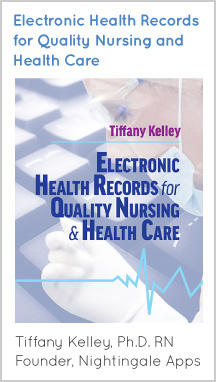
There are over 3 million nurses in the United States. Nurses become nurses to provide care to patients. Nurses do not go through nursing school, to become nurses,  and subsequently struggle with finding and entering information into electronic charting systems, often referred to as Electronic Health Records (EHRs). Nurses currently struggle to have the information they need about their patients at their fingertips. Yes, EHRs are the way to go in the sense that we need electronic record of information in order to apply more advanced algorithms and analytical reports on the data to improve population health outcomes. I do support the need for EHRs and even wrote a textbook for nurses and health care professionals about EHRs () to drive quality patient care.

Electronic Health Records for Quality Nursing and Health Care

I have worked in this field of informatics for the last 12 years and enjoy the work but I see how hard it is on nurses providing direct care and it takes a toll on their experience and overall job satisfaction. Thus we need a solution that interacts with the EHR. The solution is to provide nurses with tools that support how they work that improve their ability to be efficient. We’ve created that solution with Know My Patient TM and it has been met with remarkable praise from nurses.


So, what I didn’t say to that person who asked me the question: How did you know that your idea was good enough to start a business?” was that the problem is big enough that it deserves a solution. Additionally, the solution should be developed in such a way that addresses the needs of nurses to alleviate the challenges faced each day (look for my next blog post: 5 reasons why nurses need apps for more specific information).

“You are taking my vitals on a post-it note!?”

“You are taking my vitals on a post-it note!?”

I said these words a few weeks ago during a doctor’s visit. When it was my turn to be seen, I was brought back to a very small room and the nurse said, “I need to take your vitals”. She sat me down and started with my blood pressure. I turned my head to my left to look at what she was doing and that was when I saw it:

the yellow post-it note.

yellow-post-it-note

I reacted with: “Oh my, you are taking my vitals on a post-it note!?” The nurse responded, “ Well yes, I have to put them (e.g., my vital signs) in the computer.”


My mind started to race… ‘My vital patient information that can potentially be used over time, to assess my physical health status while under the care of this practice, is being written down on a post-it note.‘

Read more