“That is a training issue.”

Anyone who works with technology development knows that there will be a time when someone will say, “That is a training issue”. This statement often comes after someone asks, “how will the user know how to do <insert workflow step>?”

Sometimes the technical steps are not necessarily intuitive to the user’s anticipation of what to do next. This is a mismatch in the user experience. When this occurs, the user has (at best) confusion in trying to identify the next step. The confusion can lead to extreme frustration that halts progress toward completing the next step in the process (and lost time). 

Example: Pop Up Window Advertisements

Consider when you see a pop-up window to save you 10% on your first order for any given advertisement. You may or may not be interested in the welcome discount. If not, it can be quite difficult to find the “X” on the screen to exit the offer. You look around all four corners and sometimes need to locate the very faint area where you can exit out. If not found, you could exit the screen or put in your email to just get to what you wanted to see. (Of note, this is likely by design to obtain your email address  ). 

The lack of visibility of the “X” is a user experience or more specifically, a usability design issue. Sure, one could say it is a training issue and tell each person they need to look VERY CAREFULLY each time they accidentally find themselves with a discount offer. However, this becomes the user’s issue rather than the system design issue that removes this extra step. This usability design issue turns into a training issue. The usability shifts from the responsibility of the system designers to that of the individual to “learn” how to “workaround” the intended design.

Healthcare Training Issues

Now, let us look at healthcare. Healthcare is dependent upon clinical and administrative information systems to manage the individual and population level care. However, most clinicians are not formally educated on the foundations of informatics and/or information system design. Therefore, there is an inherent concern and perhaps intimidation faced where there is concern about whether they are charting the right way. 

Some clinicians will over chart while others will struggle to know what exactly needs to be charted and may unintentionally miss something. The extremes here are a result of a culture, especially in nursing, of “if it is not documented, it is not done”. However, when it becomes hard to know where to go next or how to enter some data correctly, you see the (largely unintentional) risk of error.  Add to this baseline, a handful of “training issues” and we have just added more stress to an already  stressed and fatigued workforce. 

Of course there are some aspects that do require training. However, for a moment think about how many times you have turned to watch a video or training session to use your new smart phone. Much of what you need to be able to do with your smart phone or device can be figured out without a training session.

We should be striving for this type of user experience with healthcare technology.  The need for formal training sessions should be minimal or very brief. Instead, the design of the systems should be such that the user is able to follow what the next step is through an intuitive human computer interaction experience. 

There is an abundance of qualitative and quantitative data to show that nurses, doctors, and healthcare professionals in general are working against the clock each day. There are never enough minutes to go around for everything that needs to get done in that shift. To add more things to what is expected of them will only increase the burden felt rather than create relief.

Healthcare cannot be delivered without the use of technology. However, we must consider that we have a workforce already spread thin. Instead of putting more responsibility through “training issues”, why not create a sense of ease and/or intuitive flow for them to experience each day? 

~ Dr. Kelley

The problem is big enough that it deserves a solution.

Article Thumbnail

“How did you know that your idea was good enough to start a business?”


I was asked this question in reference to my idea to create Know My Patient TM and then a business around it, Nightingale Apps LLC. It was a question I hadn’t been asked before. My response at that time was that I never questioned it, rather I just knew it was good enough.


For those who are not familiar, I created Know My Patient TM, Nightingale Apps’ patent-pending mobile workflow nursing solution, in an effort to address the daily challenges faced by nurses each day to access, enter and use information for the purpose of providing their patients with the best care.

Know My Patient


In a world where we, as consumers, rely on our phones to support our own personal information needs, answer our own questions, and allow for quick entry of information to communicate with others, we must bring that to our nurses. After all, our nurses are saving lives each day. Their focal point is the patient and whatever the patient needs, where he/she needs it.


When I came up with this idea several years ago, I could not accept that nurses would continue to rely on workaround solutions with scraps of paper, be bogged down with moving heavy ‘mobile’ carts (as their mobile solution), stay late (most if not all shifts) to catch up on charting, and feel as though they have turned into ‘glorified data entry specialists’. If we continue to make it challenging for nurses to do their work, we will likely end up driving nurses away from the profession. The statistics show we cannot afford to do that and take care of the population.


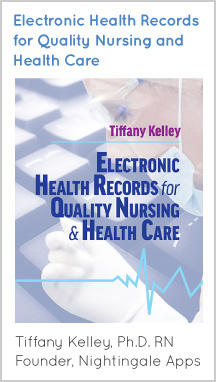
There are over 3 million nurses in the United States. Nurses become nurses to provide care to patients. Nurses do not go through nursing school, to become nurses,  and subsequently struggle with finding and entering information into electronic charting systems, often referred to as Electronic Health Records (EHRs). Nurses currently struggle to have the information they need about their patients at their fingertips. Yes, EHRs are the way to go in the sense that we need electronic record of information in order to apply more advanced algorithms and analytical reports on the data to improve population health outcomes. I do support the need for EHRs and even wrote a textbook for nurses and health care professionals about EHRs () to drive quality patient care.

Electronic Health Records for Quality Nursing and Health Care

I have worked in this field of informatics for the last 12 years and enjoy the work but I see how hard it is on nurses providing direct care and it takes a toll on their experience and overall job satisfaction. Thus we need a solution that interacts with the EHR. The solution is to provide nurses with tools that support how they work that improve their ability to be efficient. We’ve created that solution with Know My Patient TM and it has been met with remarkable praise from nurses.


So, what I didn’t say to that person who asked me the question: How did you know that your idea was good enough to start a business?” was that the problem is big enough that it deserves a solution. Additionally, the solution should be developed in such a way that addresses the needs of nurses to alleviate the challenges faced each day (look for my next blog post: 5 reasons why nurses need apps for more specific information).

“You are taking my vitals on a post-it note!?”

“You are taking my vitals on a post-it note!?”

I said these words a few weeks ago during a doctor’s visit. When it was my turn to be seen, I was brought back to a very small room and the nurse said, “I need to take your vitals”. She sat me down and started with my blood pressure. I turned my head to my left to look at what she was doing and that was when I saw it:

the yellow post-it note.

yellow-post-it-note

I reacted with: “Oh my, you are taking my vitals on a post-it note!?” The nurse responded, “ Well yes, I have to put them (e.g., my vital signs) in the computer.”


My mind started to race… ‘My vital patient information that can potentially be used over time, to assess my physical health status while under the care of this practice, is being written down on a post-it note.‘

Read more

Nurses need to be cared for too.

I envision a day in the near future where we can support nurses with tools that allow them to spend more time with their patients and less time searching for information needed to provide safe, efficient care.

Nurses struggle to efficiently answer basic questions about their patients, often not just for themselves but also for the patient’s families and the larger health care team.

What basic questions you might ask? Below is a list of a small subset of the many questions nurses get asked each day while providing patient care:

  • Have my (the patient’s) labs/exams/test results come back yet?
  • When is the patient due for meds?
  • Does the patient have any allergies?
  • When can I (the patient) go home?

In each of the above questions, nurses need to provide an answer. How do they find that answer? Well, maybe they know from their memory, but if not, nurses have this trusted tool in their pocket: a piece of paper. 

Read more

It is all about the process.

I am a nurse, an informaticist, and at times, I am also a patient. Last summer, I made an appointment for a vision exam. I was getting into my car to drive to the office when I noticed I had a voice mail. The voice mail was from the office letting someone else know that her glasses were in and she could come pick them up. I thought, ‘well that is strange, I’ll have to let them know when I get there that they called the wrong number’. What I should have done was call right back. Had I called back, I would have found out that my appointment needed to be rescheduled due to a malfunction with the equipment that day. (Instead, I drove to the office and found out in person). Although, had I called when I got the voicemail, I wouldn’t have identified the informatics challenge I saw upon arrival to the office. Read more

The Opportunity to Use Technology to Effectively Engage Family & Friends

Promoting patient-provider relationships and patient engagement in one’s own health care delivery are two topics that often come up for current discussion. I believe both are necessary for quality patient health outcomes. However, establishing a patient-provider relationship and engaging the patient are both areas that require continuous efforts from the providers and the patients. We as health care professionals are responsible for educating patients and their families about the patient’s health condition. Yet, the patient (and family) is also responsible for ensuring an understanding of his or her health condition, as well as asking questions to clarify the disseminated information. Read more