“That is a training issue.”

Anyone who works with technology development knows that there will be a time when someone will say, “That is a training issue”. This statement often comes after someone asks, “how will the user know how to do <insert workflow step>?”

Sometimes the technical steps are not necessarily intuitive to the user’s anticipation of what to do next. This is a mismatch in the user experience. When this occurs, the user has (at best) confusion in trying to identify the next step. The confusion can lead to extreme frustration that halts progress toward completing the next step in the process (and lost time). 

Example: Pop Up Window Advertisements

Consider when you see a pop-up window to save you 10% on your first order for any given advertisement. You may or may not be interested in the welcome discount. If not, it can be quite difficult to find the “X” on the screen to exit the offer. You look around all four corners and sometimes need to locate the very faint area where you can exit out. If not found, you could exit the screen or put in your email to just get to what you wanted to see. (Of note, this is likely by design to obtain your email address  ). 

The lack of visibility of the “X” is a user experience or more specifically, a usability design issue. Sure, one could say it is a training issue and tell each person they need to look VERY CAREFULLY each time they accidentally find themselves with a discount offer. However, this becomes the user’s issue rather than the system design issue that removes this extra step. This usability design issue turns into a training issue. The usability shifts from the responsibility of the system designers to that of the individual to “learn” how to “workaround” the intended design.

Healthcare Training Issues

Now, let us look at healthcare. Healthcare is dependent upon clinical and administrative information systems to manage the individual and population level care. However, most clinicians are not formally educated on the foundations of informatics and/or information system design. Therefore, there is an inherent concern and perhaps intimidation faced where there is concern about whether they are charting the right way. 

Some clinicians will over chart while others will struggle to know what exactly needs to be charted and may unintentionally miss something. The extremes here are a result of a culture, especially in nursing, of “if it is not documented, it is not done”. However, when it becomes hard to know where to go next or how to enter some data correctly, you see the (largely unintentional) risk of error.  Add to this baseline, a handful of “training issues” and we have just added more stress to an already  stressed and fatigued workforce. 

Of course there are some aspects that do require training. However, for a moment think about how many times you have turned to watch a video or training session to use your new smart phone. Much of what you need to be able to do with your smart phone or device can be figured out without a training session.

We should be striving for this type of user experience with healthcare technology.  The need for formal training sessions should be minimal or very brief. Instead, the design of the systems should be such that the user is able to follow what the next step is through an intuitive human computer interaction experience. 

There is an abundance of qualitative and quantitative data to show that nurses, doctors, and healthcare professionals in general are working against the clock each day. There are never enough minutes to go around for everything that needs to get done in that shift. To add more things to what is expected of them will only increase the burden felt rather than create relief.

Healthcare cannot be delivered without the use of technology. However, we must consider that we have a workforce already spread thin. Instead of putting more responsibility through “training issues”, why not create a sense of ease and/or intuitive flow for them to experience each day? 

~ Dr. Kelley

“I’ll be back in a few minutes..”

This is the truth… (I chuckled when I read it).

This reminded me of when I’d come back from the cafeteria around 3:30pm (having started at 7am) with something I grabbed to bring back and eat for lunch on the unit. The unit secretary would see me and tell me something like:

“Your patient in room 10 needs pain medicine, room 5 is due in radiology, room 8’s parent is on line 2 and you have new orders for room 1.” I would just look at her and think, ‘how are you keeping a straight face as you are telling me this news? (and I can’t do all 4 of those things at the same time?)’.

Nurses are a Blessing

Post originally appeared on Dr. Tiffany Kelley RN on November 28th, 2017

Nightingale’s Innovative Nurse: (November): Amelia Roberts, RN


Meet Amelia Roberts, RN

Amelia Roberts

What do you love about being a nurse?

What I love about being a nurse is the perspective I get! From where I stand, I see life with all that it offers, both problems and solutions. In my nursing role, we deliver patient care in a variety of forms. This viewpoint shows me both challenges and opportunities that patients face in navigating the healthcare system. In my role as caregiver, I have a clear view of solutions that support how care is delivered. Nursing gives such a unique perspective of what works on the user interface side. This viewpoint also shows clearly, what does not work in terms of user experience. Being an end user of a variety of healthcare technologies, I see many well-meaning companies who hope to facilitate communication among providers and disconnected healthcare systems. As a nurse, I feel it is a duty to contribute to solving these and other challenges that impact patient care.

How does contributing to solve these challenges look?

A few years ago there was a Hackathon at a local healthcare facility. I submitted an idea on an app that would facilitate discharge planning. As a finalist, I had the opportunity to see my app go from idea on paper to an experience that I could actually engage with on an iPad! Not much happened from there. Due to various system-level challenges, the app could not be put into practice. Since then I’ve been actively engaged in conversations with a variety of tech companies who offer similar discharge planning solutions. In my role as a provider of solutions, I find joy and connecting such founders with Healthcare Champions and health care decision-makers. My aim in facilitating these conversations is to break down some of the silos that prevent cross-pollination of ideas.

What do you love most about being a nurse?

Thinking of the unique perspective of the registered nurse, I would love for more technology companies to seek out having nurses as part of their team, if not only as a focus group. It would make sense to have these nurse stakeholders part of the conversation during the front end development of Technology as well. Many times nurses are included on the back end in terms of creating workflows for implementation. Many challenges are discovered during implementation that could have been avoided if nurse input was sought earlier in the process.

Related to solving this challenge,  I’ve enjoyed participating in a variety of electronic medical record user-testing opportunities. What I love about nursing is the opportunity that it gives me in connecting the problems I see with solutions that are out there ready to be used. If you would like to continue the conversation, please shoot me an emailamelia@solutionsbyamelia.com.


Business Website www.solutionsbyamelia.com

Personal Blog: The Story Behind My Business

Twitter and Instagram @RN_Solutions

Nightingale’s November Newsletter

Did you catch our November Newsletter?

Here’s an excerpt:

While I get to share my story, I also get to offer a perspective that perhaps is new. Yet, I hope that perspective lights that initial spark that can be taken back to the workplace and think differently about how to solve some of the challenges faced in our health care environment. 

You can read the full newsletter here: Nightingale’s November Newsletter . To be added to our mailing list, email us at contact@nightingaleapps.com or sign up on the website!


The power of perseverance.

Perseverance is an essential characteristic when embarking on something new.

I was a PhD student for 4 years. Some students took 5 years to complete the degree. Yet, I knew I wouldn’t be able to sustain a fifth year. I needed to finish in 4 years. I spent the first two years of the program trying to demonstrate that there was value in studying nursing documentation. More specifically, I studied the information needs of nurses before and after an electronic nursing documentation system implementation. I remember being in a class one day and the professor looked at me and said, “no one cares about nursing documentation”. Ouch!

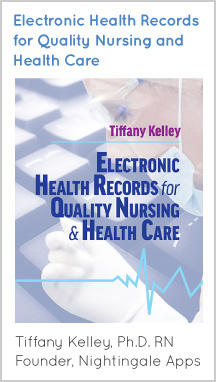
My first paper wasn’t accepted until I was in my 3rd year of the program. Yet, it was accepted with very little changes required to the Journal of Nursing Scholarship. That paper was what caught the attention of a publisher that led to them asking me to write my book, Electronic Health Records for Quality Nursing and Health Care. (So, it turns out MANY people care about nursing documentation… 😉 ). I applied for many external grants before finally figuring out the best way to present the case. I worked tirelessly every day. After that, I had several grants funded with a total of 7 by the end of my PhD program.

I remember thinking (often) ‘would it really happen, would I finally get this PhD degree?’ I also remember thinking it had to be preparing me for something else that would come. I couldn’t think of any other reason why it was so painful and difficult for that long of a time frame. That something else was entrepreneurship. Starting a business from an idea (e.g., Nightingale Apps) requires extensive perseverance (and many other characteristics). Instead of being in one academic setting, your ecosystem is much larger with greater variability in perspective. There aren’t set protocols and when you have something brand new, (e.g., Know My Patient), there isn’t a path already paved for you to follow. You need to be the one to figure it out. You also need to decide who and what to listen to as you go down this path. Everyone will have an opinion but you’ll need to decide which one(s) are aligned with your vision.

“The truth is, there is only so far ‘motivation’ can carry you and your vision when you are in the grind (especially in the early days). People watch you from afar, some half-expecting you to fail, and after all the good wishes and pep talks, you are only left with yourself — and your willingness to keep going.”

https://www.goalcast.com/2017/12/01/secrets-persevering-when-all-you-want-to-do-is-give-up/

Post originally appeared on Dr. Tiffany Kelley RN on December 4th, 2017