Nurses Rank #1 for 24th Year in a Row

Every year, since 1976, the Gallup Poll releases Ethics Rankings for American Professions. On January 12th, the Gallup Poll’s 2025 rankings were released and again ranked nurses at the top of the list for ethical standards. This result is the 24th consecutive year of ranking at the top of the list of professions.

I speak on this often but why this year feels different is due to the continued socio-technical challenges we face with finding the right balance between what humans can do (and should do) versus what technology can do (and should do) in healthcare.

I started my career as a bedside nurse. Every shift I strived to give the best possible care available to each of my patients. Sometimes this meant refusing patients because the ones I had needed me too much to take on another one. Sometimes this meant pushing the medical or surgical team to decide who was responsible for the patient because the data I had did not look quite right to me. Sometimes this meant spending hours sifting through papers to figure out when the newly transferred ICU patient was due for meds because it just was not at all as clear as it could be. “It’s all there” I might hear. (Yes, it is all there buried in dozens of pages of small print).

Your decisions are guided by what is best for the patient as well as what is ethically sound. The nurse patient relationship is essential to know that patient and for the patient to know one’s care. Establishing trust is critical for that relationship as patients are vulnerable to the care they receive and who is providing that care.

Therefore, as we advance technology such as artificial intelligence that is more complex for the population, there must also be awareness on how these tools do or don’t work. Any technology tool that is used becomes an extension of the human’s care delivery. With approximately 50% of the U.S. population concerned about the use of AI in daily life, this creates a potential for mistrust in the care environment if AI is not articulated, understood and effectively used consistently for care.

Thus, as nurses and healthcare professionals, it is critical that we advocate for the tools that can assist in ways that improve our experience in delivering quality patient care rather than replace core functions of what it means to be a nurse. The patients depend on it, even if they do not say it.

~ Dr. Kelley

Healthcare Innovation: It Takes the Time that it Takes

Did you know that the first electronic health records (e.g., EHRs) were developed in the late 1960’s and early 1970’s? I did not know this when I first came to know them in the early 2000’s. I naively thought, ‘how hard can it be to take paper records and turn them into an electronic form?’.


Well, the answer to that question, it is very hard! Despite the efforts during my first few years with EHRs, I was unaware of the fascinating history that came alongside this new way of digitalizing patient information until I began writing my book on EHRs. EHRs are a case study for demonstrating that healthcare innovation is a different marketplace.  With so many influential factors, bringing innovation to healthcare environments takes the time that it takes.


Dr. Lawrence Weed conceptualized the idea for a ‘problem oriented medical record’ in 1968. His thoughts were published in the New England Journal of Medicine. He saw the opportunity to leverage technology in a way that physicians could manage patient information according to problems and understand the whole patient as a person. Dr. Weed saw the opportunity to support the clinician with information needed for decision making, and care delivery. Weed did not use the term ‘electronic health record’ or EHR, nor did any of his peers that were developing the first EHR systems. The term used at that time was ‘computerized patient record’ or CPRs.


During that time, several organizations began developing systems for use within their facilities: Duke, Massachusetts General Hospital, Beth Israel Deaconess Medical Center and the Department of Veterans Affairs are just a few of these pioneers. These efforts began nearly 50 years ago. However, fast forward 40 years and the United States had been at less than 2% adoption in 2009.


While we may not think of it now, the EHR is an innovation in healthcare. AHRQ defines healthcare innovation as, “the implementation of new or altered products, services, processes, systems, policies, organizational structures, or business models that aim to improve one or more domains of health care quality or reduce health care disparities”    (https://innovations.ahrq.gov/faq). The EHR is an example of how diffusing innovation in healthcare does not happen overnight.


I sometimes wonder where we, the United States, would be had the HITECH Act not made financial incentives available to accelerate the adoption of EHRs in health care organizations. I suspect the adoption rates would not be what they are today. As of the end of Q2 of this year, less than 2% of hospitals and outpatient practices were at a Stage 0 on the HIMSS EMRAM  (electronic medical record adoption model). In less than 10 years, the United States went from less than 2% adoption to less than 2% non-adoption!


Now, imagine you were Dr. Lawrence Weed or any of the pioneers that developed the early EHRs. Imagine the hurdles experienced to bring the idea and early concepts to life and acceptance. Imagine how many people said ‘that will never happen’ or ‘you can’t do that’ and over how long of a period of time it likely was expressed by others. Fifty years is a very long time.


EHRs faced financial, technical, organizational and legal barriers toward rapid adoption. The HITECH Act helped to breakdown some of the financial barriers. In general, healthcare innovation needs to overcome each of these barriers toward successful implementation and adoption.


In some cases, the technical environment and the organizational culture wasn’t quite ready for EHRs. Legally, the protection of electronic PHI was not defined until 2003 with the Security Rule. Thus, despite the conceptualization and recognition of the potential in the 1960’s, the healthcare innovation took the time that it needed before it could be accepted into the environment.


I believe this is a helpful perspective for those that are developing new innovations in healthcare. The general ecosystem of innovation tends to paint a picture that one can develop a solution and have it lead to rapid widespread adoption within a very short period of time. (For example, Instagram started in 2010 and was sold to Facebook in 2012 for 1B). Yet, the healthcare marketplace is not the same as the consumer marketplace. In many cases, the consumer of the innovation in healthcare is not the purchaser of the product. Additionally, the previously mentioned barriers become less conflated when managed at an individual (e.g., person/user) level rather than a system (e.g., health care organizational) level. Thus, the adoption of new innovations within healthcare organizations requires the time that it takes.

Best,

Dr. Tiffany Kelley RN


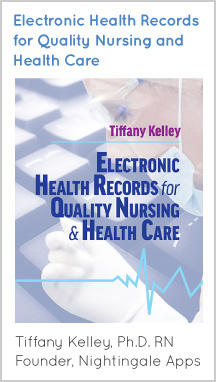
For more information about my book, Electronic Health Records for Quality Nursing and Healthcare, visit Destech Publications at: http://bit.ly/2a6pJpz.


12279141_10206802826123482_3052069955447221008_n


Nurse Entrepreneurship & Nightingale’s Innovative Nurses

I knew very little about entrepreneurship when I started down this path several years ago. I had the idea and vision for Know My Patient®. I knew that every bedside nurse deserves an opportunity to have accurate, up to date information needed for patient care at their fingertips. I knew chasing after information was a waste of their time and energy when it could be sent to them electronically and available in a mobile device from the comfort of their pocket. I knew nurses wanted to feel like nurses and not data entry specialists. Thus, I decided with these knowns, the best way to bring Know My Patient® to life would be to start a company, Nightingale Apps.

Know My Patient


However, unlike the rest of my career to date at that time, I did not have a nursing mentor to help guide me through the general process of taking an idea, bringing it to life, and then turning it into a company. At that time, I did not know of any other Nurse Entrepreneurs. While I didn’t see that as a barrier to my desired pathway, many others would often try to deter me from the chosen path. I reached a point where I could see in someone’s eyes that he or she was thinking. “You are going to do what?”. Instead of letting the reactions deter me, I decided to begin to learn what it meant to be an entrepreneur and learn from others.


The word entrepreneur is as “one who organizes, manages, and assumes the risks of a business or enterprise”. Applying that definition, the Nurse Entrepreneur is one who has identified an opportunity to solve a problem in health care that can be executed through a business entity. We all know there are many opportunities to improve health care. However, we, as nurses, don’t all realize that deciding to take on that opportunity can be a viable, profitable option that drives an impact on those whom you are providing your product, service or solution.


I remember hearing from someone several months ago, “You’re a nurse and an entrepreneur? I didn’t know you could do that.” That statement gives me a chuckle because there really are no barriers to entrepreneurship. There are no degree requirements or certifications required to start down this path. What you do need is an entrepreneurial way of thinking, an idea, and a plan to execute that you are willing to adjust as you begin to pave your own path.


You might be thinking, “Well, is it (e.g., entrepreneurship) hard?” Yes, it is hard. Nursing school is hard. The NCLEX is hard. Caring for sick and dying patients is hard. Entrepreneurship is a different kind of ‘hard’ work. However, I always come back to what it felt like to care for patients and their families. Nurses save lives every day. If you can do that, you are well equipped for a path toward entrepreneurship. However, you have to want to do it and it will not be a path for everyone. That is ok too.


Over the last several months I’ve been introduced to several Nurse Entrepreneurs and Innovators. With each new week, I learn of other nurses that have decided to create their own path and are thriving in their niche. I have also learned of nurses who have created solutions in health care that I never knew started from a nurse. For example, the crash cart and the Wong-Baker Faces Scale both started from a nurse who identified a problem with the current method of managing code situations or childhood pain.


I often talk to groups about how we as a profession need to be our best advocates. We need to demonstrate the power of our profession by modeling the way to others. Instead of complaining about some of our professional challenges (my personal pet peeve is how nurses are portrayed in television), we need to turn that around and be more on the offense in a positive constructive way. We must show others what we do and how we do it. Perhaps we will inspire others to become nurses. Perhaps we will reduce stereotypes of what we do at the bedside or what our capabilities are as professional nurses. With so many available outlets at our fingertips today, we have the ability to make an impact for others with minimal barriers.


To take a first step toward this, I decided that we, Nightingale Apps LLC, would form an initiative to showcase other entrepreneurial (and intrapreneurial) nurses who are identifying opportunities where they are making a strong, positive impact on health care through their unique skill sets and perspective on what is currently missing. This initiative is called, Nightingale’s Innovative Nurses and we will be showcasing these nurses through our Nightingale Apps newsletter and social media outlets.


Our first Innovative Nurse, Andrew Craig, RN, is a Travel Nurse that has started his own Travel Nurse business, HubbleSweet PLLC and has a YouTube channel with videos to help educate nurses on the Travel Nurse industry. You can learn more about him and his entrepreneurial mindset here: .


NA_AndrewCraig_InnovativeNurse_091817


I’d like to invite any of you reading this who are interested in learning more or being featured to either reach out to me directly or to our team at contact@nightingaleapps.com. We’d love to learn about what you are doing and/or someone else that you might know who fits this description. The Nightingale Apps team and I are excited about this effort. As much as we need nurses to care for patients, we also need nurses to pave new paths for those to come and give a view into what else is possible within the nursing profession.


Best,


Dr. Tiffany Kelley

12279141_10206802826123482_3052069955447221008_n


‘Do I nurse the computer or nurse the patient?’

Have you ever found yourself thinking ‘do I nurse the computer or nurse the patient?’ during your nursing shift? If the answer is yes, you are not alone. This phenomenon of ‘nursing the patient versus nursing the computer’ did not exist when I was a new nurse in 2000. This phenomenon emerged over the last decade as the nation has moved from a paper-based medical record system to the use of electronic health records (EHRs). However, unless you are a nurse (or health care professional) actively involved in providing direct patient care, this phenomenon may not be well known to you.  


The phenomenon of nursing the patient versus nursing the computer is an internal struggle. The internal struggle is visible in the nurse’s behavior but not often verbalized by the nurse. As nurses, we are there to care for our patients. I have yet to meet a nurse who entered the profession because of their joy for charting. Instead, entering the profession often comes from the joy of caring for other people, our patients, during our shifts.  


We, as nurses, know charting is part of our role and responsibilities. We learn this through nursing school courses, practicums and our preceptorship when first starting as a nurse in the health care organization. We respect the practice of charting, or documenting, on our patient. Yet, in many cases, the patient should be the priority over that of the chart. Thus, our instinct is often to care for the patient before caring for the patient’s record of information. However, there are times when this decision becomes a struggle for the nurse.  

  Read more

Transitioning from the Bedside: One Skill for Success

I often receive questions from other nurses, informaticists, entrepreneurs and students about things on their mind and what they should do or how should they do something. If one person is having the question, there are likely others as well. So last month I decided to use Facebook live as a method of addressing these questions on a weekly basis on my page: Tiffany Kelley PhD RN

In many of my videos I  mention that there were some core business skills that I had to learn when I left bedside nursing and transitioned into a more business oriented nursing role (e.g., specifically informatics and IT).These business skills included appropriate use of email, excel, powerpoint, and many others to start.

Another skill is how to have an effective phone meeting with someone.

I wanted to offer some tips on how to structure a phone call so that you can effectively utilize the time you have with that person. This can be applied to any situation!

20841719_834613966699334_3733627427687919706_n

Many people will offer you 15 or 30 minutes to start which is NOT a lot of time so you want to make sure you can use the time effectively and also make sure that person felt his/her time was well spent too!

So…if you are going to reach out and request to speak with someone, the best way to get the conversation going once on the call is to:

1. Set the stage for the call by telling the person why you are calling.

2. Briefly introduce yourself and/or company.

3. Ask the person to tell you a little about themselves to fill in any gaps that you might have from your prep research before the call (ps…you should be prepared for the call) .

4. After this, you can move on to the true purpose of the call – why you wanted to have the phone meeting.

5. It is also best to end the call with what to expect next and who is responsible for those next steps.

PS…If you need to for the first few calls, put this outline together and fill in the blanks to keep track of where you are so that time does not run out on you.

?It is a simple outline to follow that really does work well! ?

I hope this helps some of you who might be starting to get going with a new venture, adventure, etc. – whatever it might be!

Have a great day and let me know what you think!


Best,
Tiffany12279141_10206802826123482_3052069955447221008_n

PhD versus DNP: Which one should you choose?

Are you deciding upon a doctoral degree in nursing? There are two primary choices: a Doctor of Philosophy (PhD) and a Doctor of Nursing Practice (DNP). Both degrees are supported by the American Association of Colleges of Nursing (AACN) and represent terminal degrees in the field of Nursing. However, there are differences between the two degree programs that prospective students should be aware of before selecting one or the other.

In this linked video, I compare the PhD and DNP in the field of Nursing. I look forward to hearing your thoughts.

DNP versus PhD: Which one should you choose?

Best,

Tiffany